

In the race to reduce industrial emissions and meet the growing demand for critical raw materials, one startup is turning CO₂ waste into the solution. UP Catalyst, an Estonian deep-tech company, has developed a novel method to convert industrial CO₂ into valuable carbon materials like graphite and carbon nanotubes.
These materials are the foundation for batteries, construction materials, and next-generation electronics. What sets UP Catalyst apart, however, is their production. They operate with significantly lower energy levels, low costs, and zero fossil fuels. This means they are helping industries reduce emissions when creating high-performance products.
A space-born idea with Earth-sized potential
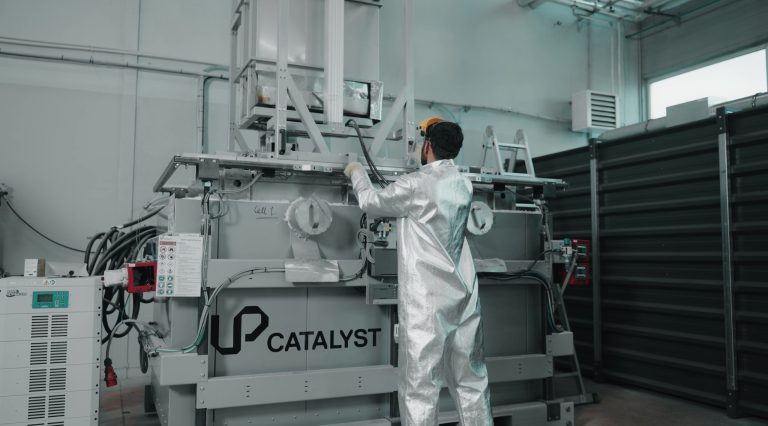
The origin of UP Catalyst’s innovation is as bold as its mission. The core electrochemical process was originally developed by NASA for oxygen production on long-duration space missions. UP Catalyst ventured beyond and focused on the carbon left behind in this process. Carbon, which can be re-engineered into sustainable, high-performance materials.
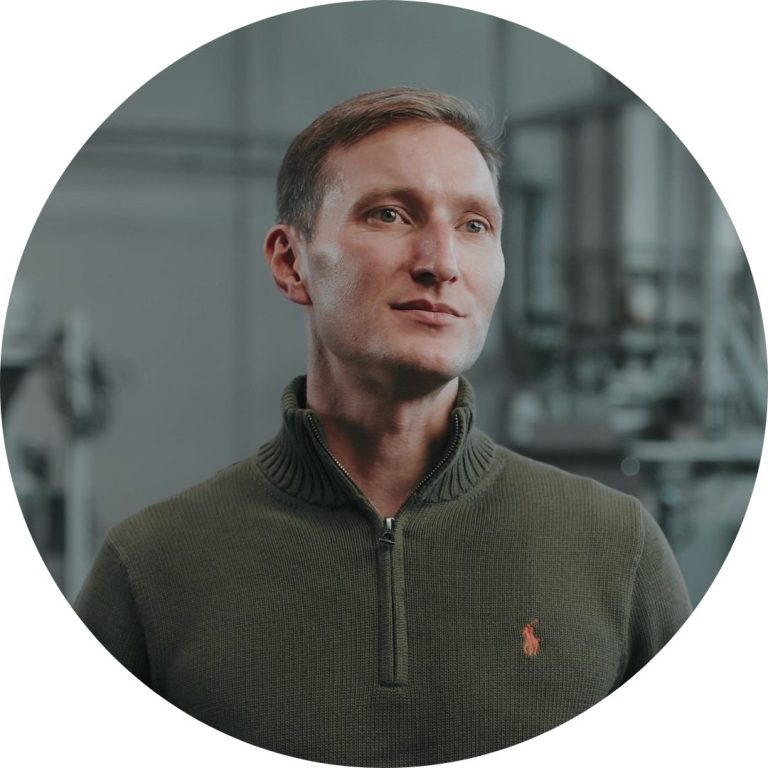
“We founded UP Catalyst with a bold vision: to give CO₂ a green purpose,” says Dr Sebastian Pohlmann, Chief Technical Officer at UP Catalyst.
“And when the European Commission selected UP Catalyst as a Strategic Project under the Critical Raw Materials Act, it confirmed that what we’re building isn’t just viable — it’s essential for Europe’s resilience.”
The challenges of scaling under pressure and building a new materials economy
On one hand, they’re facing the challenge of disrupting the established supply chains of the battery raw materials market. This conservative market still relies heavily on imported materials and the startup is going up against global fossil-based carbon suppliers. Unlike the others, UP Catalyst’s process eliminates environmental harm and positions Europe for greater material independence.
On the other hand, mastering the heat balance and thermal stresses in their reactor systems was another hurdle to overcome. UP Catalyst’s production process operates at extreme temperatures — up to 800°C — demanding high material integrity and system precision. According to their team, managing thermal stress with different materials of construction is crucial to the success of scale-up activities.
Precision engineering to scale fast with SOLIDWORKS Simulation
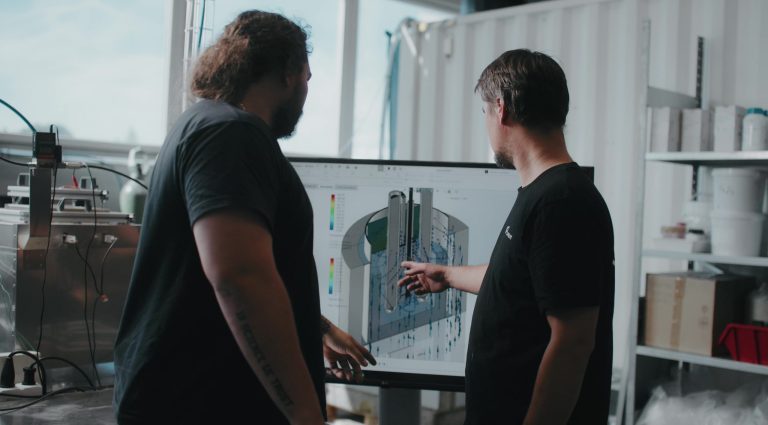
To solve these technical challenges, UP Catalyst turned to SOLIDWORKS, specifically SOLIDWORKS Simulation. These solutions allowed them to model heat flow, structural stress, and vibration damping digitally. This reduced costly trial-and-error in physical prototyping.
Dr Pohlmann is confident, “Using SOLIDWORKS has allowed us to move from concept to scalable reactor production faster and with more confidence.”
SOLIDWORKS has been a core part of their engineering workflow from reactor design to custom-built gas handling and purification systems.
“Our team relies heavily on 3D modelling, assemblies, and drawing tools to rapidly prototype new cell designs and production modules. The parametric modelling features allow us to test design iterations quickly, while maintaining tight dimensional control,” Dr Pohlmann adds.
UP Catalyst’s Lead Engineer Aleksandr Fomichev explains in more detail: “We’ve used SOLIDWORKS Simulation to model thermal expansion, stress distribution under high loads, and vibration damping in our reactor assembly.” Additionally, they use simulation tools for their material selection process, especially for parts exposed to high temperatures and corrosive environments.
Design philosophy for growth
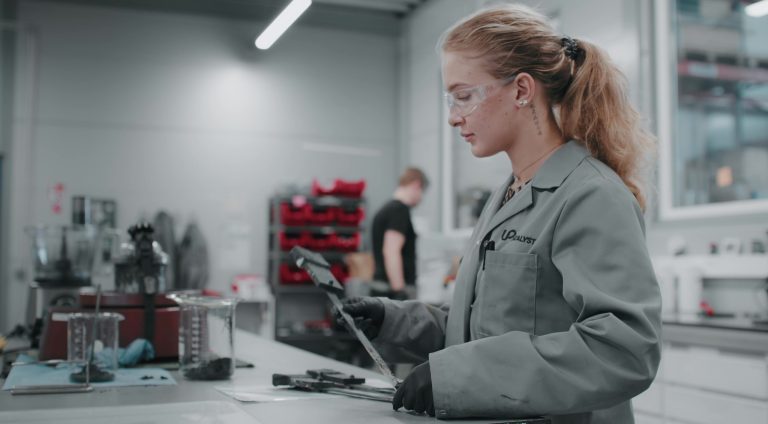
Their philosophy for scale is rooted in modularity. Dr Pohlmann says: “We have learned that it is best to design production processes in unit cells that can be re-used at larger scales – saving costs and reducing risks as we grow.”
This strategic approach has now evolved into a vision for gigaton-scale production. In the coming years, the startup plans to scale production tenfold annually. Ultimately, they’re aiming to supply carbon materials for 1 million electric car batteries by 2030.
Looking ahead, their CAD work will involve even more complex interlocking systems and large-scale assemblies. The ability to simulate, test, and iterate digitally remains a cornerstone of their innovation strategy.
PLM Group as a long-term partner
UP Catalyst joined PLM Group’s SOLIDWORKS for Startups program early on. Through the program they received discounted licenses for SOLIDWORKS that proved crucial in their formative years. They see the value in PLM Group’s training offers and are planning this as a valuable next step. With our support, UP Catalyst is aiming to fully unlock the potential of their toolset.
“Beyond the tools themselves, it’s valuable to know we have a partner we can turn to as our needs evolve,” shares Dr Pohlmann.
UP Catalyst is giving CO₂ a green purpose
The startup is on a journey to reshape the materials supply chain. They continue to prove that carbon-negative, high-performance materials are both viable and competitive. Now, the company is opening the door for entire industries to rethink how essential materials are made.
With a bold idea, relentless engineering, and the right digital tools, they’re a living example how exploration leads to innovation. Turning emissions into assets is no longer a dream, but a reality.
Do you want to scale your production faster and more efficiently?
This startup makes the most of simulation tools to understand how their products will perform in the real world, saving costs and time.
Read more about Simulation here, look into the SOLIDWORKS for Startups program and reach out to us to learn how we can help your business scale better and faster.
Get in touch
We understand investing in the future is a huge decision. We are happy to have a conversation with you about your goals and how we can help you reach them. Please contact us today, and we’ll guide you every step of the way towards success.


