A single source of truth
ERP Integration in 3DEXPERIENCE
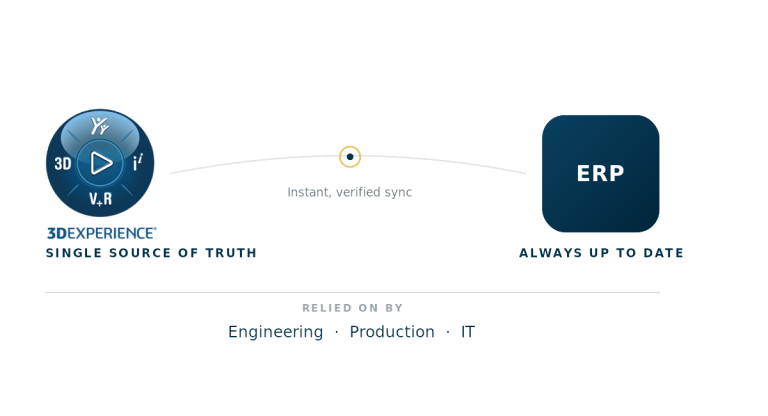
Stop entering the same data twice. Connect 3DEXPERIENCE with your Enterprise Resource Planning (ERP) system and benefit from information flowing automatically.
WHY AN ERP INTEGRATION SOLUTION?
PLM and ERP are different ends of the same rope
Work smoother when every system running your business is in sync. Update something once in 3DEXPERIENCE and it lands in your ERP instantly and correctly.
Just one set of data that engineering trusts, production can build from, and IT doesn’t have to babysit.
Without the right integration between your engineering structure and operational data, someone ends up retyping BOMs, chasing the latest revision, or fixing errors that never should have happened.
Our Integration Platform connects 3DEXPERIENCE to your ERP, MES, PIM, or any other business system and keeps them in sync automatically.
Benefits of ERP integration
Flexible setup.
Configure the integration to match your workflows and your ERP system, not a generic template.
Direct data mapping.
PLM objects link cleanly to ERP materials, BOMs, and routings, so the connection stays consistent.
Automatic updates.
Change something in one system and it appears in the other without manual sync or forgotten steps.
Controlled data flow.
You set the rules: what moves, when and under what conditions.
Built-in monitoring.
Every exchange is logged, with status and error reporting.
HOW DOES IT WORK?
Two platforms matched to how you deploy.
You can choose between two Integration Platform options:
- Installed in your environment:
The standard route for SOLIDWORKS PDM – and, depending on your setup, an option for an on-premise 3DEXPERIENCE deployment too. The integration runs inside your own infrastructure, under your control. - Hosted by us in the cloud:
Used primarily for 3DEXPERIENCE integrations today, with the capability to support PDM as well.

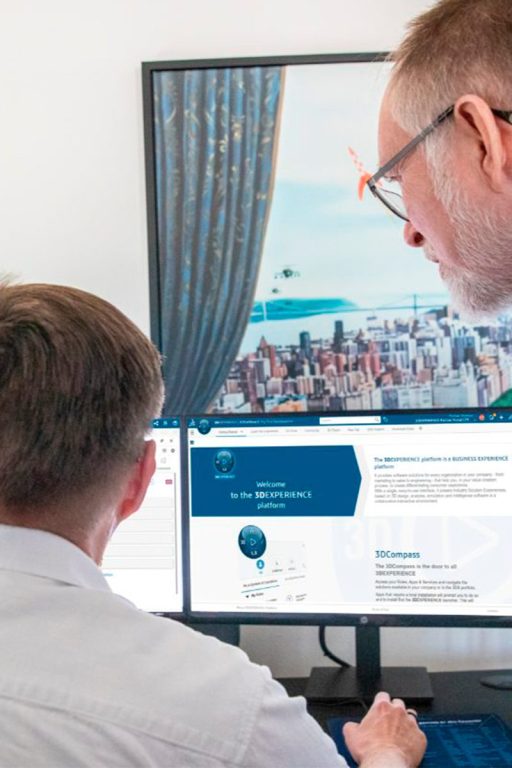
Whichever platform fits your setup, the approach is consistent:
bi-directional exchange of data and files, delivered through a connector built for that system’s specific interface and your integration scenario.
This is not a one-size-fits-all template, it’s tailored to your specific needs where every exchange is logged, so status, history and errors are always visible.
The cloud-hosted platform additionally runs on a loosely coupled, asynchronous, event-based model. This, in practice, means that a temporary outage on one side doesn’t break the other, and a release or change triggers the integration automatically.
Examples of systems we connect today:
ERP, MES, PIM, document management systems, and other tools across your value chain. If it exposes an interface, we can very likely connect to it.
WHO IS IT FOR?
Managers from every part of the process.
Where does engineering end and operations begin?
Every manufacturer draws that line somewhere.
PLM owns the design: the structure, the BOM, the change history.
ERP owns the operation: purchasing, inventory, scheduling, cost.
The moment a design is released for production is where the two have to meet and where most of the manual work and errors happen today.
If you’re the IT Manager
You’re not signing up for another system to babysit.
The architecture is loosely coupled and event-based, so an outage on one side doesn’t cascade into the other.
Every exchange is logged — status, history, errors — so when something does go wrong, you know exactly where, not just that it did.
Rollout is scoped to your environment, not a generic template.
If you’re the Engineering Manager
Your team didn’t sign up to be a data-entry relay between design and production.
Release a BOM in 3DEXPERIENCE, and it shows up correctly on the other side — automatically, the same revision, every time. No chasing whether the latest change actually made it through.
If you’re the Production Manager
What lands on your floor should match what engineering actually released — not what it released two revisions ago.
With data flowing automatically, you’re not relying on someone remembering to update a spreadsheet.
Fewer surprises mid-run. Fewer scrapped parts because of a BOM that was already out of date.

THE BUSINESS CASE
What’s actually at stake when data doesn’t move on its own.
“The lack of seamless data structures often causes delays of six to twelve months, and budget deviations of 30–50% are common.”
— CEO, High-End Subcontractor Specialist, Towards a Smarter Industry
(Kairos Future research, commissioned by PLM Group)
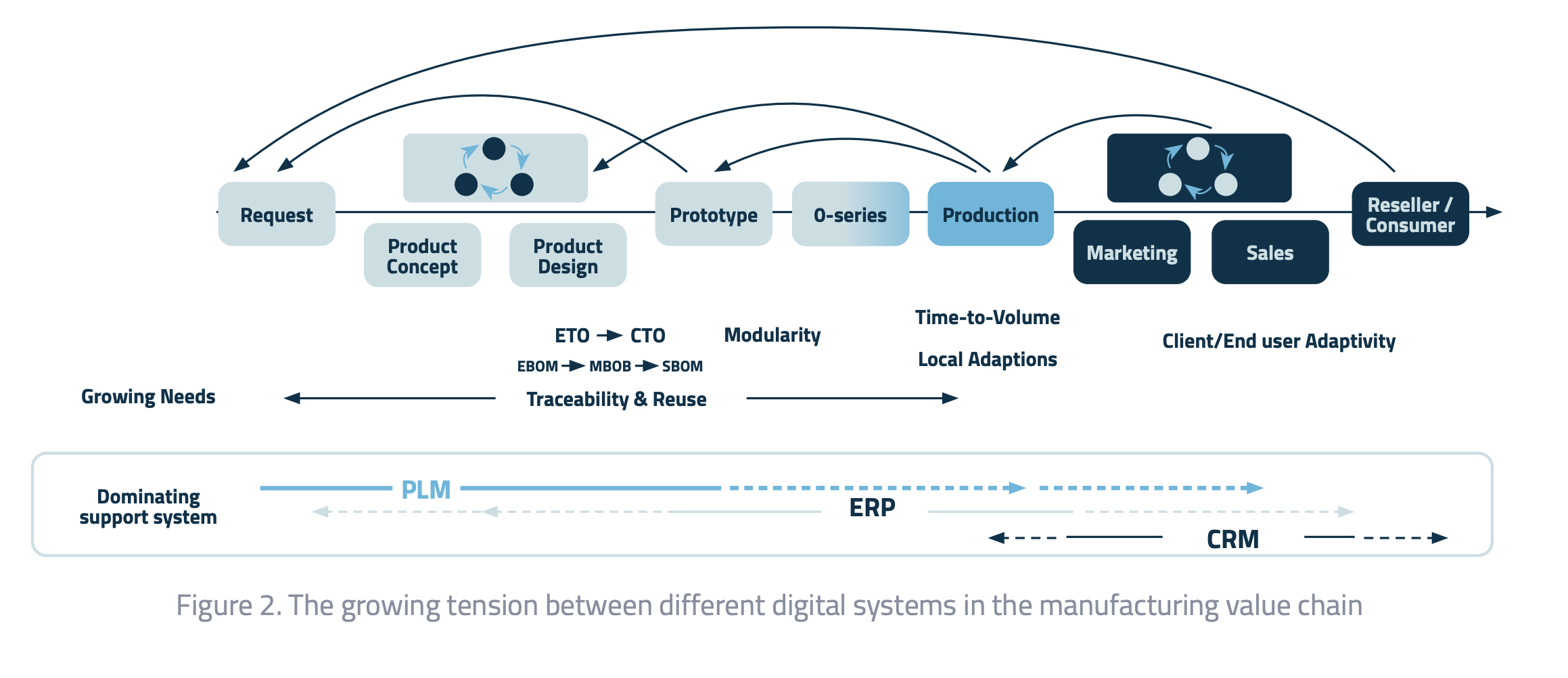
Click on the picture for bigger view
NOT ON 3DEXPERIENCE YET?
This works for SOLIDWORKS PDM too.
Integration isn’t reserved for 3DEXPERIENCE customers.
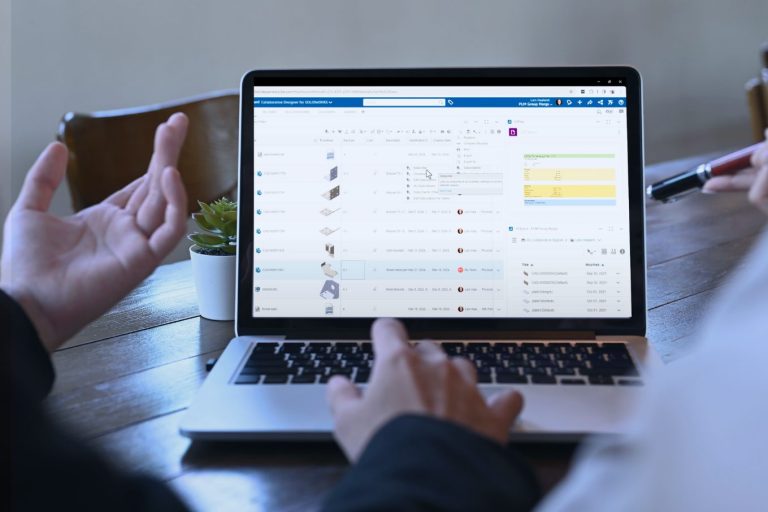
If you’re running SOLIDWORKS PDM, our Integration Platform – installed in your own environment – connects your PDM data to ERP and other business systems.
Single source of truth without migrating first.
Frequently asked questions
Here are the answers to the most frequently asked questions about this solution.
Do you have a question that is not displayed here? Contact us here
What is the PLM Group Integration Platform?
It’s a cloud-hosted or locally installed solution that connects 3DEXPERIENCE or PDM with the other systems your business runs — ERP, MES, document management, and more. Data and files move in both directions, built on industry best practice, so it stays reliable as you scale and safe to upgrade.
Which systems can be integrated?
Any system that exposes an integration interface. That includes ERP systems, MES and manufacturing systems, document management systems, and custom or legacy applications. We support REST and SOAP APIs, file-based integrations (XML and others), DLL-based APIs, direct database connections, and file transfers.
Is the integration bi-directional?
Yes. Data and files flow from 3DEXPERIENCE or PDM to your other systems, and back, depending on your process and your governance rules.
How does the cloud integration architecture work?
We build on the 3DEXPERIENCE Enterprise Integration Framework: loosely coupled, asynchronous, and event-based. Your systems aren’t tightly dependent on each other, so a temporary outage on one side won’t break the other. When something changes – a release, an update – the integration reacts automatically. Less risk, easier to maintain.
How is security handled?
Through every layer: secure communication between systems, controlled access to integration interfaces, and a clear separation between customer environments. Want specifics — authentication, data residency, encryption? We’ll map those out as part of your solution design.
Does this work with SOLIDWORKS PDM, or only 3DEXPERIENCE?
Both – through different platforms. PDM integrations typically run on our Integration Platform installed in your own environment. 3DEXPERIENCE integrations are usually cloud-hosted by us, though an on-premise setup is possible too. Either way, the outcome is the same: one source of truth, without migrating first.
Explore related solutions:

EBOM Management
Manage your Bill of Materials (BOM) on a single platform to ensure accuracy and consistency across all departments.

Change Management
Save time, improve quality, and reduce risks with a streamlined change governance process that minimizes human errors.

Variant Management
Simplify your variant & portfolio management with a platform that boosts cross-functional collaboration, from initial product introduction to market withdrawal.
GET IN TOUCH
Let’s talk about what’s not connecting yet.
Investing in connected systems is a huge decision and we know it.
Bring IT, engineering and production into the conversation or just start with your own corner of the problem.
Tell us how things are set up today and we’ll tell you what’s possible.